










Validation of a Competitive Marketing Model for Achieving Competitive Advantage of Iranian Cosmetic and Personal Care Products in the Iraqi Market
|
The objective of this study was to develop and validate a competitive marketing model that explains how Iranian cosmetic and personal care products can achieve sustainable competitive advantage in the Iraqi market. This study adopted a mixed-methods sequential exploratory design grounded in a pragmatic paradigm. In the qualitative phase, a systematic grounded theory approach was employed using semi-structured interviews with academic and industry experts in marketing and the cosmetic and personal care sector, selected through purposive and theoretical sampling until theoretical saturation was achieved. Qualitative data were analyzed through open, axial, and selective coding to develop a conceptual competitive marketing model. In the quantitative phase, a structured questionnaire derived from the qualitative findings was administered to 384 marketing experts and practitioners. Structural equation modeling was applied to assess the measurement and structural models, evaluate model fit, and test the hypothesized relationships among constructs. Inferential results indicated that causal factors had a positive and significant effect on the core phenomenon of competitive marketing. Contextual factors and intervening factors both exerted significant positive effects on competitive marketing strategies. Furthermore, competitive marketing strategies showed a strong and significant impact on marketing outcomes related to competitive advantage. Model fit indices confirmed that the proposed structural model demonstrated an excellent fit with the empirical data, supporting the validity of the hypothesized relationships. The findings confirm that achieving competitive advantage in the Iraqi market requires an integrated competitive marketing system that aligns internal marketing capabilities with contextual and intervening environmental conditions and translates them into coherent strategic actions and outcomes. |
The Effect of Job Enrichment on Employees’ Organizational Well-Being in Selected Martial Arts Federations: The Mediating Role of Resilience
|
The purpose of this study was to examine the effect of job enrichment on employees’ organizational well-being in selected martial arts federations, with the mediating role of resilience. The present research employed a descriptive–correlational design, and data were collected through field methods using questionnaires. The statistical population included all employees of the martial arts, judo, wushu, karate, and taekwondo federations, totaling 337 individuals, from whom 175 participants were selected as the statistical sample using proportional stratified random sampling. Data collection instruments included the Job Enrichment Questionnaire by Hackman and Oldham (1980), the Organizational Well-Being Questionnaire by Amraollahi and Danaei (2013), and the Connor–Davidson Resilience Scale. Data analysis was conducted using correlation coefficients, multiple regression analysis, and structural equation modeling. All statistical analyses were performed using PLS and SPSS software. The results indicated that job enrichment has a significant effect on organizational well-being and resilience among employees of the selected martial arts federations, explaining 47.33% of the variance in organizational well-being and 19% of the variance in resilience. In addition, resilience was found to have a significant effect on organizational well-being, accounting for 10.04% of its variance. Furthermore, the results of the Sobel test demonstrated that resilience plays a mediating role in the relationship between job enrichment and organizational well-being among employees of the selected martial arts federations. Accordingly, it is suggested that strengthening employees’ resilience can substantially enhance the effect of job enrichment on organizational well-being in martial arts sport federations. Therefore, managers of these federations are recommended to implement appropriate planning—particularly in the areas of training and resilience development—to facilitate employee growth and improve working conditions. |
Examining the Role of Organizational Intelligence and Moral Intelligence in Enhancing Organizational Learning with Emphasis on the Mediating Role of Organizational Entrepreneurship
|
The aim of this study is to examine the role of organizational intelligence and moral intelligence in enhancing organizational learning, with emphasis on the mediating role of organizational entrepreneurship. Although the pairwise relationships among these variables have been examined in previous studies, integrating them within a unified framework—particularly by considering organizational entrepreneurship as a mediating variable in Iranian service and healthcare organizations—constitutes a significant research gap. Most domestic studies have focused solely on direct relationships and have not employed advanced methods such as structural equation modeling to test mediation effects. In addition, limited attention has been paid to moral intelligence alongside organizational intelligence, especially in the healthcare sector, which is fundamentally grounded in trust, accountability, and ethics, despite the potential of this combination to exert a profound influence on organizational learning. The present research adopts a descriptive correlational design. The statistical population includes all employees—permanent, contractual, and service staff—of the West Azerbaijan Province University of Medical Sciences and Health Services, totaling 15,000 individuals. The sample size was determined using Morgan’s table, resulting in the selection of 375 participants, who were randomly chosen to complete the questionnaires. Data collection instruments consisted of standardized questionnaires, which, after reassessing and confirming validity, credibility, and reliability and updating them in accordance with current information, were administered to the sample. To confirm or reject the research hypotheses through scientific methods, Cronbach’s alpha coefficient (α = 0.923) was used to assess questionnaire reliability, and the Kolmogorov–Smirnov test was employed to examine the normality of the data. Data analysis involved descriptive statistics, including frequencies, percentages, means, charts, and relevant tables, to describe the statistical samples, and inferential analysis to test all research hypotheses using path analysis and structural equation modeling, conducted with LISREL software. The results indicate that organizational intelligence and moral intelligence have a significant effect on organizational learning through the mediating role of organizational entrepreneurship at the West Azerbaijan Province University of Medical Sciences and Health Services. |
Providing the Consumer Behavior Model with a Green Marketing Approach
|
This study aimed to investigate the direct and indirect effects of cause-related marketing on green consumption attitude, intention, and behavior among cosmetics consumers in Tehran. This research employed a mixed-methods design consisting of a qualitative phase for identifying CRM and green consumption components through meta-analysis and expert interviews, followed by a quantitative phase using structural equation modeling (SEM). In the qualitative phase, 20 marketing experts contributed to component extraction using MAXQDA and content analysis. In the quantitative phase, 450 questionnaires were distributed among cosmetics consumers in Tehran, yielding 387 valid responses. The model included four latent constructs—cause-related marketing, green consumption attitude, green consumption intention, and green consumption behavior—measured using both researcher-developed and standardized scales. Reliability, convergent validity, and discriminant validity were evaluated prior to SEM estimation. SEM results indicated that cause-related marketing had significant positive effects on green consumption behavior (β = 0.660, p < 0.001), green consumption intention (β = 1.105, p < 0.001), and green consumption attitude (β = 0.945, p < 0.001). Green consumption intention significantly predicted behavior (β = 0.021, p = 0.034), while green consumption attitude significantly predicted both behavior (β = 0.330, p < 0.001) and intention (β = 0.251, p = 0.001). Indirect pathways were also significant, including CRM → attitude → behavior (β = 0.311, p < 0.001), CRM → attitude → intention (β = 0.237, p = 0.001), CRM → intention → behavior (β = 0.023, p = 0.042), and attitude → intention → behavior (β = 0.005, p = 0.009). Cause-related marketing exerts strong direct and indirect influences on consumers’ green attitudes, intentions, and behaviors, demonstrating its strategic importance in closing the green attitude–behavior gap and promoting sustainable consumption in the cosmetics industry. |
Analysis and Examination of Factors Affecting the Productivity of Mining and Mineral Industries Organizations for Performance Improvement and Productivity Enhancement Based on the Grounded Theory and Fuzzy DEMATEL Approach
|
Organizations active in mining and mineral industries play an influential role in the economic growth and development of societies. Therefore, the present study was conducted with the aim of analyzing and examining the factors influencing the productivity of mining and mineral industries organizations to improve performance and enhance productivity based on the grounded theory and fuzzy DEMATEL approach. The present study is applied in terms of purpose and mixed-method in terms of implementation. The research population consisted of industry experts and specialists, as well as university faculty members in the field of mining and mineral industries at the Iranian Mineral Processing Research Center and its parent organization (IMIDRO). The sample size in the grounded theory and fuzzy DEMATEL sections was estimated at 30 and 40 individuals, respectively, selected through purposive sampling. To collect data, semi-structured interviews were used in the grounded theory section, and a researcher-developed pairwise-comparison questionnaire was used in the fuzzy DEMATEL section. In this study, to identify influential factors, open, axial, and selective coding methods were employed based on the grounded theory approach, and to determine the degree of influence and influenceability, the fuzzy DEMATEL method was used. The results of grounded theory indicated that the factors influencing the productivity of mining and mineral industries organizations for performance improvement and productivity enhancement consisted of 51 open codes, 25 axial codes, and 12 selective codes. The causal conditions included 10 open codes and 6 axial codes categorized into 3 selective codes: improvement of organizational structure and processes, technological infrastructure, and technology and innovation. The contextual conditions included 12 open codes and 4 axial codes in 2 selective codes: human resource empowerment and macro-level economic and policy factors. The intervening conditions included 12 open codes and 7 axial codes in 3 selective codes: leadership, management and policymaking, organizational risk and safety management, and supply chain and resources. Strategies included 9 open codes and 4 axial codes in 2 selective codes: operational management and productivity, and human capital development. The consequences included 8 open codes and 4 axial codes in 2 selective codes: economic and financial performance, and sustainability and social responsibility. Moreover, the results of fuzzy DEMATEL showed that the criterion of leadership, management, and policymaking, with a value of 7.1404, had the highest level of influence. After that, the criteria of economic and financial performance and improvement of organizational structure and processes ranked next, with values of 6.9473 and 6.9315, respectively. In addition, the technology and innovation criterion, with a value of 7.1678, had the highest degree of influenceability, followed by operational management and productivity and technological infrastructure, with values of 6.8736 and 6.8535, respectively. Furthermore, criteria C6, C10, C5, C11, and C1 were identified as causal variables, while criteria C4, C9, C12, C2, C8, C7, and C3 were classified as effect variables. According to the findings of this study, in order to enhance the productivity of mining and mineral industries organizations for performance improvement and productivity enhancement, conditions can be created to improve the identified codes and variables reported in this research. |
Examining Managerial Factors Influencing the Tendency of Bandar Abbas Citizens to Use Instagram
|
The present study aims to examine managerial factors influencing the tendency of Bandar Abbas citizens to use Instagram. The research method employed in this study is cross-sectional in terms of temporal dimension; operationally, it is an applied investigation, as the researcher seeks to establish a logical relationship between scholarly work and the target population. Given the nature of the topic, the data collection procedure, and the characteristics of the statistical population, a survey method was utilized. The statistical population of this study consists of the citizens of Bandar Abbas. The sample size includes 384 citizens of Bandar Abbas. To collect data, the study used the Virtual Network Usage Motivation Questionnaire (Gülnar et al., 2010). The data obtained from the questionnaires were analyzed statistically using SPSS software. The findings revealed a significant relationship between the use of the Instagram social network and immersion in virtual space (r = 0.001), between the use of the Instagram social network and the motivation for interaction and communication in virtual space (r = 0.001), between the use of the Instagram social network and self-expression in virtual space (r = 0.001), and between the use of the Instagram social network and entertainment motivation in virtual space (r = 0.001). Based on the results, it can be concluded that individuals’ motivation to join Instagram is not unidimensional; rather, it is multidimensional and multifaceted, varying from one person to another and from one culture to another. The results of this study may offer valuable theoretical and practical implications for managers and policymakers in this domain. |
The Relationship Between the Extent of Using Product and Service Images in Virtual Networks and the Dominant Atmosphere of Political Interactions with the Increase of Iran–Gulf Cooperation Council (GCC) Trade Exchanges
|
The purpose of this study is to examine the relationship between the extent of using images of products and services in virtual networks and the dominant atmosphere of political interactions with the increase in trade exchanges between Iran and the Gulf Cooperation Council (GCC) countries. Survey research is the method employed in the present study. The statistical population consisted of 541 merchants and virtual-space journalists in Tehran, from which 28 individuals were selected as the sample based on Cochran’s formula. To develop the research literature, concepts, and theoretical studies, a library method using note-taking techniques and a questionnaire was applied. SPSS software was used to analyze the data. The calculated Cronbach’s alpha for twelve Likert-scale items demonstrates acceptable reliability; the computed reliability was 0.904, indicating a satisfactory level of internal consistency. The results showed that the test of the two variables—extent of image usage and various visual components—with a value of 18.903 and a significance level of 0.000, is confirmed with 99% confidence and a 1% error level; therefore, the use of various images in virtual networks plays a role in increasing trade exchanges between Iran and the GCC countries. The test of the two variables—dominant atmosphere of political interactions between Iran and the GCC countries for increasing trade exchanges—with a value of 1.489 is also confirmed; thus, the dominant atmosphere of political interactions between Iran and the GCC countries, with a correlation coefficient of 0.889 indicating a desirable correlation, has an effect on increasing trade exchanges. |
Assessment of the Effectiveness of Iraq’s Futsal Development Model: A Structural Equation Modeling (SEM) Approach with Emphasis on Performance Indicators
|
The objective of the present study was to assess the effectiveness of Iraq’s futsal development model using a Structural Equation Modeling (SEM) approach with an emphasis on performance indicators. This study aims to evaluate and validate the causal relationships among the primary dimensions identified after formulating the initial futsal development model in a previous qualitative research phase. The research design was applied in nature and, in terms of execution, descriptive–analytical and quantitative. The statistical population consisted of coaches, players, referees, and futsal managers in Iraq. The sample included 300 experts in this field, selected using purposive–convenience sampling. The data collection instrument was a researcher-made questionnaire based on eleven components (national barriers, international barriers, motivational elements, private-sector participation, bureaucracy and relations, domestic and global standards, legal and executive frameworks, economic and financial infrastructures, software and hardware infrastructures, professionalization, and cultural–social enhancement). The questionnaire’s validity was confirmed by subject-matter experts as well as through confirmatory factor analysis, and its reliability was reported with a Cronbach’s alpha above 0.81. Structural equation modeling using LISREL was employed to test the model. The results indicated that the fit indices were at an acceptable level (CFI = 0.93, RMSEA = 0.068, χ²/df = 2.41), and the relationships among the model dimensions were significant. Moreover, the model quality assessment was confirmed. Therefore, Iraq’s futsal excellence model possesses sufficient statistical validity and can serve as a basis for sports policymaking in the country. |
About the Journal
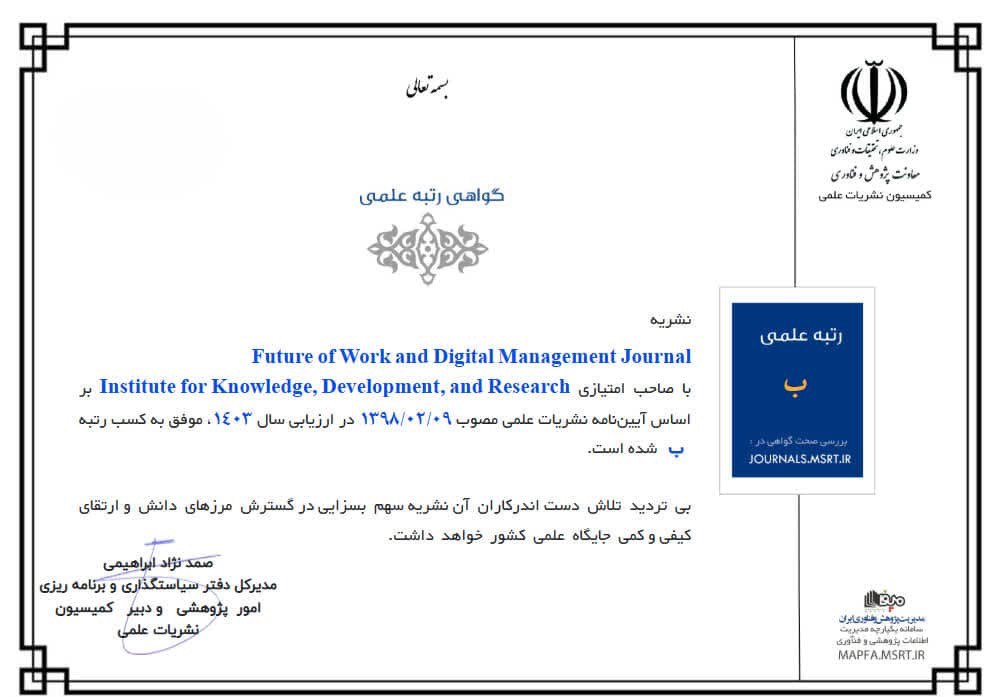
The Future of Work and Digital Management Journal (FWDMJ) is an international, peer-reviewed, open-access academic journal dedicated to the study of the evolving nature of work and management in the context of rapid digital transformation. The journal seeks to bridge the gap between scholarly research and practical application by exploring emerging paradigms, innovative practices, and the socio-technical dynamics that are reshaping work environments, managerial roles, and organizational structures across industries and geographies.
The FWDMJ serves as a scholarly platform for researchers, practitioners, policymakers, and thought leaders interested in understanding how digital technologies—including artificial intelligence, machine learning, blockchain, remote collaboration tools, and data-driven decision-making—are altering the landscape of work and the principles of management. The journal fosters interdisciplinary dialogue by publishing high-quality, original research articles, conceptual papers, case studies, and reviews that offer fresh insights into the future trajectories of work and managerial processes.
As an open-access journal with a rigorous double-blind peer-review process, the FWDMJ upholds the highest standards of academic integrity, research transparency, and editorial excellence. The journal is published online quarterly, and all accepted articles are made freely available to the global scholarly community without subscription or paywall barriers.
Current Issue
Articles
-
Analysis of Factors Affecting Managers’ Political Intelligence Using the Meta-Synthesis Technique in Public Sector Organizations
Somaieh Taghipourvajargah , Mehran Mokhtari Baye Kalaei * , Ghorbanali Aghaahmadi , Aliosat Khanjani1-12 -
Developing a Foresight Framework for the Publishing Industry Based on a Hybrid Approach
Ramuna Mirhajian Moghadam , Alireza Naser Sadrabadi * , Ali Morovati Sharifabadi , Seyed Mahmood Zanjirchi1-16